How Did Specific Ancient Cultures Interpret Fate And Its Relationship To Their Gods Or Deities?
Introduction
Throughout history, ancient cultures around the world have crafted distinct narratives to understand the concept of fate and its profound relationship with deities. These interpretations provided essential frameworks for human experiences and moral structures, often mirroring the values and beliefs of their societies.
Greek Culture: The Moirai and Divine Will
In ancient Greek culture, the concept of fate was largely represented by the Moirai, known as the Fates, three sisters who wove the threads of life and determined the destinies of both mortals and gods. Their influence was significant; even the gods respected the decrees of the Fates, emphasizing the belief in a predetermined pathway intricately linked to the cosmos. Some interpretations suggest an element of personal agency, indicating that human choices might influence their fate within the limits established by the Moirai.
- Clotho spun the thread of life, symbolizing creation.
- Lachesis measured the length of the thread, representing life's duration.
- Atropos cut the thread, signifying death and the end of existence.
Norse Culture: Wyrd and the Norns
Norse mythology interprets fate through the concept of 'Wyrd', which controlled the destiny of all beings, personified by the Norns. These three female beings, akin to the Fates, determined the fates of gods and men alike. Depicted as residing under the roots of Yggdrasill, the World Tree, they represented the interconnectedness of life and destiny. Additionally, the belief that individuals could affect their Wyrd through actions and decisions is prominent in these narratives.
- Urðr represented the past, Verðandi the present, and Skuld the future, embodying the dimensions of time influencing fate.
- Wyrd was regarded as mutable, adaptable based on personal choices and actions.
Egyptian Culture: Ma'at and Divine Order
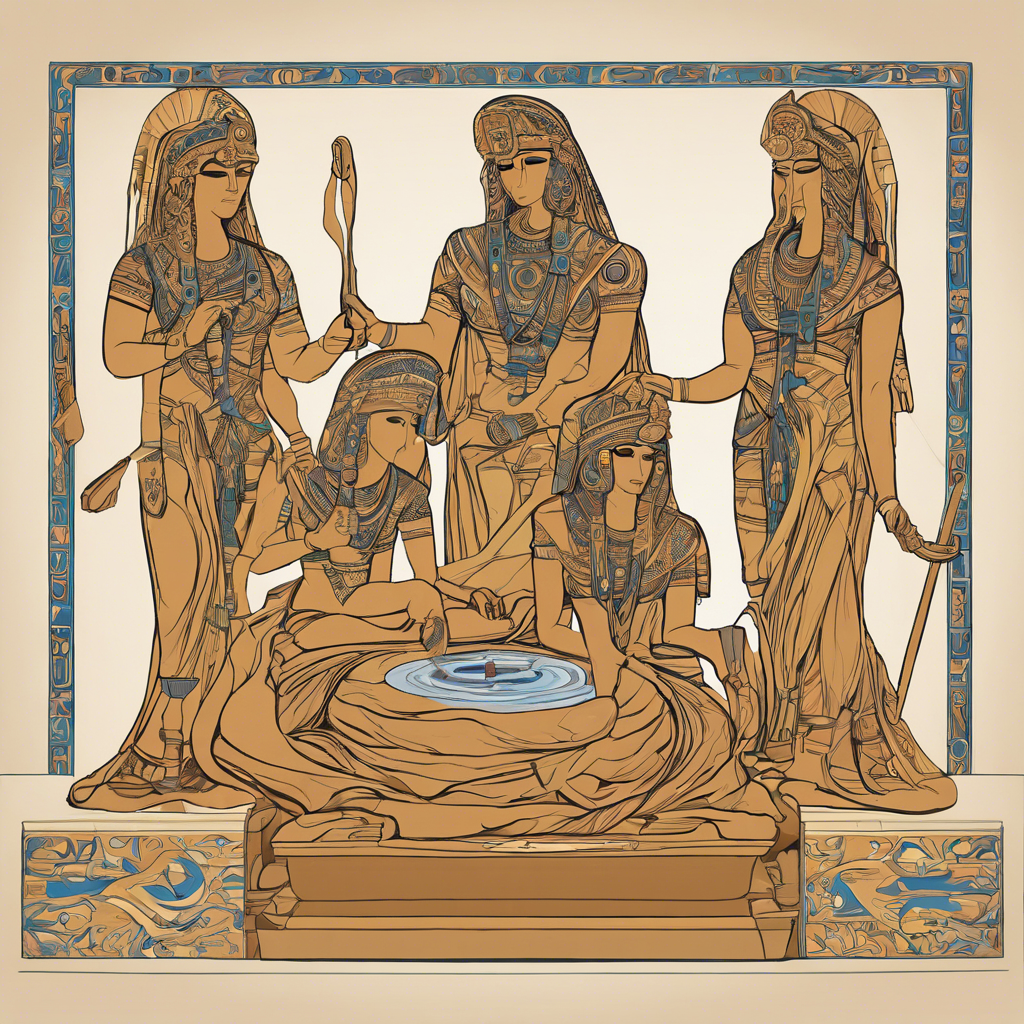
In ancient Egyptian society, the concept of fate was closely tied to Ma'at, representing truth, balance, and cosmic order. The gods were believed to maintain this order, compelling individuals to live in harmony with it. The judgment of one’s fate occurred in the afterlife, where a person's heart was weighed against the feather of Ma'at, determining the righteousness of their life and the fate that awaited them beyond death.
- A heart lighter than the feather indicated a virtuous life and a favorable fate.
- Disorder stemming from chaos would result in punishment or an unfavorable fate.
Mesopotamian Culture: Enuma Elish and Divine Decree
The ancient Mesopotamian perspective on fate is powerfully illustrated in the Enuma Elish, a Babylonian creation myth that portrays the gods as creators establishing order from chaos. Fate was considered a divine decree, immutable even by the mightiest deities, highlighting a strict cosmic hierarchy. Nonetheless, human free will was acknowledged, suggesting that individuals could influence their destinies through their actions, particularly the monarch's role as a mediator between the divine and society.
- The king functioned as the representative of the gods on Earth, with his fate intricately linked to divine will.
- Astrology and divination practices were employed to interpret the divine will and forecast personal destinies.
Conclusion
Ultimately, ancient cultures approached the concept of fate with a blend of reverence and caution, recognizing the gods' roles in shaping human experiences. These narratives highlight the depth of human contemplation about existence and the forces beyond control, illustrating a rich tapestry of beliefs that continue to resonate in modern thought.
Expert Quote
Dr. Robert E. Bell, Professor of Ancient History at Yale University
In many ancient cultures, fate was not merely a matter of chance; it was viewed as a divine construct actively governed by deities, serving as a moral compass for human behavior and societal norms.
Book: 'Divine Providence in Ancient Religions', Oxford University Press, 2019
Relevant Links
Did the Greeks really believe in their gods? : r/AskHistorians
https://www.reddit.com/r/AskHistorians/comments/17r7u6/did_the_greeks_really_believe_in_their_gods/Greek Mythology and Gods • Ancient Greeks: Everyday Life, Beliefs ...
https://www.mylearning.org/stories/ancient-greeks-everyday-life-beliefs-and-myths/415Nietzsche's declaration “God is dead” is often misunderstood as a ...
https://www.reddit.com/r/philosophy/comments/smmdsa/nietzsches_declaration_god_is_dead_is_often/Meaning of life - Wikipedia
https://en.wikipedia.org/wiki/Meaning_of_lifeFides et Ratio (14 September 1998) | John Paul II
https://www.vatican.va/content/john-paul-ii/en/encyclicals/documents/hf_jp-ii_enc_14091998_fides-et-ratio.htmlYouTube Videos
Most popular questions

How Do The Personal Relationships Among Gods Affect Their Decisions In The Iliad?
The intricate relationships among the gods in Homer's epic poem 'The Iliad' play a crucial role in shaping their actions and decisions. These divine interactions create a complex web of fates, where each god's personal alliances and rivalries directly influence the events of the mortal world.

What Strategies Can Parents Use To Educate Their Children About Online Safety Beyond Privacy Settings?
In today's digital landscape, teaching children about online safety is essential for their protection and well-being. While privacy settings play a critical role, parents can implement various strategies to create a thorough understanding of online safety principles among their children.
What Are The Different Types Of Insulation Materials Commonly Used In Buildings, And How Do They Compare In Terms Of Thermal Resistance?
Insulation materials are vital for enhancing energy efficiency in residential and commercial buildings by minimizing heat transfer. Understanding the various insulation types can lead to better choices for thermal resistance and overall comfort.
Most recent questions
What Is The Process For Obtaining A Public Performance License For A Concert?
Obtaining a public performance license for concerts is essential for musicians and event organizers to ensure legal compliance when performing copyrighted music. This licensing process protects the rights of songwriters and copyright owners while enabling artists to legally showcase their music and receive fair compensation for their performances.
How Does The Rise Of Digital Platforms Affect The Accessibility Of Traditional Publishing For New Authors?
The evolution of digital publishing platforms has dramatically reshaped the traditional publishing industry, presenting both exciting opportunities and significant challenges for emerging authors. This digital transformation fosters avenues for self-publishing and enhances access to diverse audiences while simultaneously altering the operational dynamics of traditional publishing houses.
How Does The Choice Of Cinematography Impact The Audience's Perception Of Historical Authenticity In Both Documentaries And Fictional Films?
The choice of cinematography is essential for conveying historical authenticity in both documentaries and fictional films. By employing various techniques such as lighting, composition, and camera movement, filmmakers can evoke a rich sense of time and place that greatly influences audience understanding and emotional engagement with historical material.